Imagined ancient landscape · artistic interpretation, not a reconstruction of a known site.
Three clocks. One story.
Evolution Researchers use models to estimate when ancestral lineages separated. These estimates cannot give us the birthday of a single “first plant”.
Archaeology A dated seed or residue can tell us a plant was present at a site. It cannot always tell us whether people grew it or how they used it.
Domestication Genomes and excavated remains help trace how people selected the plant over time. They can point to different dates and places.
We have chosen milestones that help tell the plant’s story. This is not a complete history of every society or an original scientific review. Our sources include genomic and archaeological research, historical scholarship, archives and official records. For some papers, only the abstract was available; publisher access can change. We keep dates and uncertainties beside the evidence they describe. BP means years before 1950. Calibrated BP and radiocarbon BP measure time differently; we use calendar BCE where a published calibration is available.
The four original scenes are AI-generated illustrations. They are not documentary images or reconstructions of a named archaeological site. This history does not establish Parvati Valley as the plant’s birthplace or verify Mount Herbs’ supply chain. A record of medical use tells us about past practice; it does not prove that a treatment works. Approvals for specific medicines do not apply to hemp seed oil or protein powder. Legal milestones explain what happened at the time; they do not give permission to possess, grow or sell cannabis.
01 / Ancestry
Before a human name
An evolutionary lineage, before recorded geography · Tens of millions of years ago
Long before anyone grew cannabis or gave it a name, its ancestors shared a history with hops. At some point, the two lineages separated. Researchers look for traces of that split in the genes of living plants. Those comparisons help estimate when it happened, but they cannot give us the birthday of cannabis as we know it today.
◌ Molecular dating estimate · 1 source
Read the evidence & its limits
A 2023 hop-genome study estimated the Cannabis–Humulus divergence at about 22.6 million years ago using a fossil-calibrated Bayesian molecular clock. Its 95% highest posterior density interval extended from approximately 15.7 to 28.8 million years. Other methods in the same study produced estimates around 16–17 million years. The spread matters: fossil calibration, sampled genes and statistical method influence the date inferred from living genomes.
Where the evidence stopsA molecular estimate is not a directly observed birth date. It does not identify the first cannabis individual, settle the plant’s precise birthplace, or establish where people first used it.
Northwestern China · northeastern Tibetan Plateau hypothesis · c. 19.6 million years ago
A plant may disappear while its pollen survives in the ground for millions of years. Researchers have used these tiny grains to trace a possible cannabis history across the ancient Asian steppe. One study proposes an origin near the northeastern Tibetan Plateau. It is a possibility pieced together from scattered pollen records and clues about nearby vegetation. The exact birthplace is still uncertain.
◌ Pollen synthesis and geographic hypothesis · 1 source
Read the evidence & its limits
McPartland, Hegman and Long reviewed 155 Asian fossil-pollen studies in 2019. Their oldest Cannabis–Humulus pollen record consistent with cannabis was dated to about 19.6 million years ago in northwestern China. Because cannabis and hop pollen can be difficult to distinguish, they used accompanying steppe or forest pollen as ecological clues. Their proposed origin near Qinghai Lake also draws on the reconstructed history of steppe vegetation.
Where the evidence stopsPollen identification and ecological inference remain uncertain. This hypothesis does not establish a particular Himalayan valley as the plant’s origin, and it cannot reveal cultivation or the chemical composition of these ancient plants.
East Asia · Okinoshima, Chiba, Japan · c. 12,000 BP model · 8280–7660 BCE remains
How did people first come to know this plant? Genes in living cannabis plants offer clues about early domestication. Fruits recovered by archaeologists give us something we can date and place on a map. Together, they point to a long relationship in East Asia. Much is still missing: we cannot tell who first grew it, how each seed was used, or every route the plant took.
◌ Genomic inference and dated archaeobotany · 3 sources
Read the evidence & its limits
A 2021 genomic study modelled a domestication-associated divergence around 12,000 years before present, with a broad 95% interval of roughly 6,458–15,728 years. Separately, directly dated Cannabis fruits from Okinoshima in Chiba have a calibrated range reported as 8280–7660 BCE in a later archaeobotanical review. The genomic result is an inference from modern samples; the Japanese finds are physical remains, with possible cultivation discussed by their investigators.
Where the evidence stopsBP means years before 1950; BCE uses a calendar scale. The evidence does not identify the first grower or prove that every early occurrence represents cultivation, fibre production or intoxicating use.
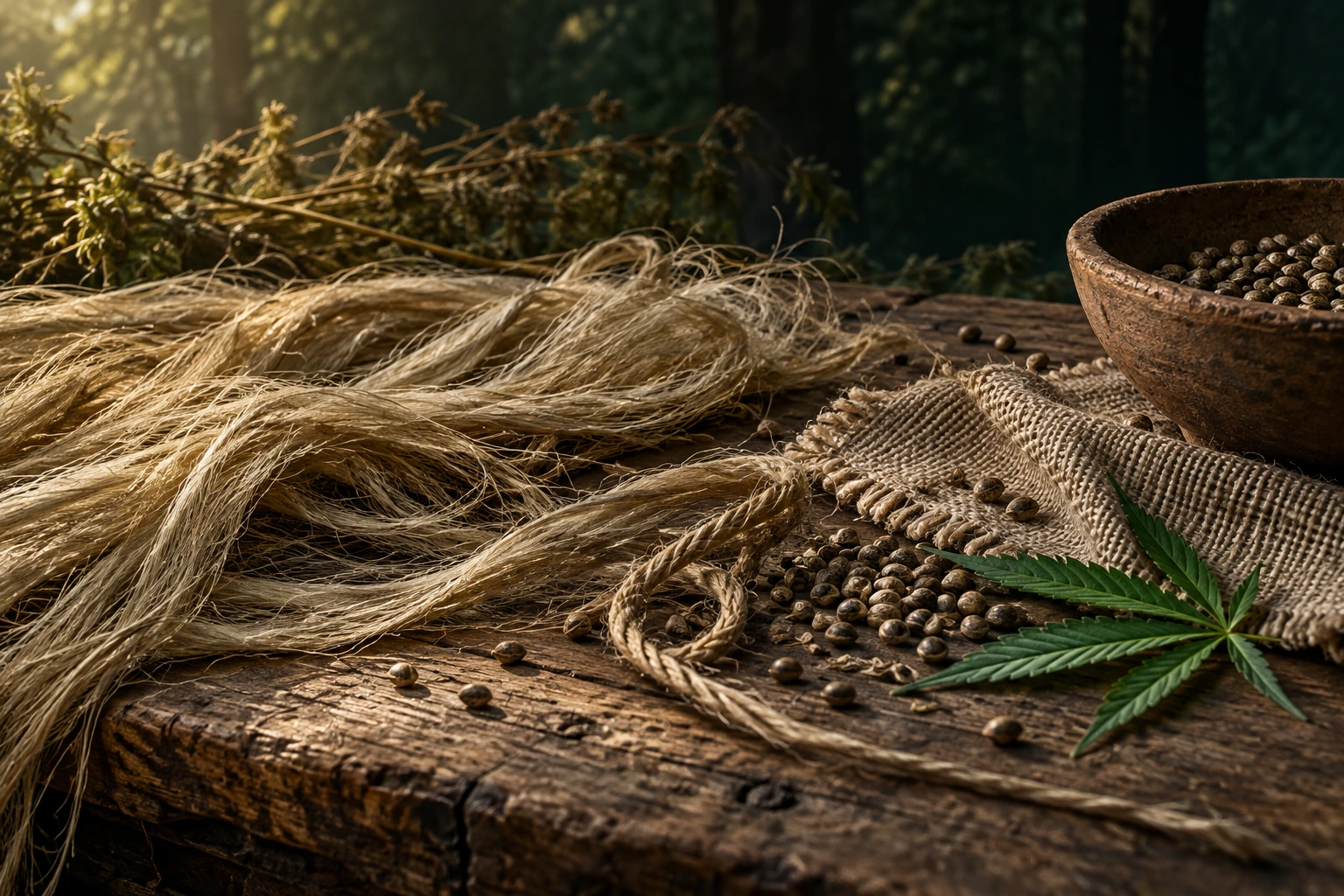
Hemp materials · artistic interpretation, not excavated objects.
04 / Useful matter
Grain, thread, cloth
Haimenkou, Yunnan · Gaocheng Taixi, Hebei · c. 1650–400 BCE
At one ancient settlement, cannabis grains survived. At another, a roll of hemp cloth did. These finds bring us closer to the ways people worked with the plant, even though they leave much of daily life unknown. A grain and a piece of cloth tell us different things. Together, they remind us that cannabis has a history of many uses, and that we cannot assume what every surviving seed was for.
◌ Archaeobotany and material remains · 1 source
Read the evidence & its limits
Research on Haimenkou reports more than 800 Cannabis grains from contexts dated approximately 1650–400 BCE, most concentrated in a deposit from 1400–1100 BCE. The same study reviews a securely identified roll of hemp cloth from Shang-period Gaocheng Taixi, approximately 1600–1046 BCE. Seed measurements support discussion of an early crop with multiple possible uses; they do not directly measure ancient cannabinoid chemistry.
Where the evidence stopsThese are separate sites and contexts. They do not demonstrate identical practices across China, reveal the use of every grain, or validate every proposed earlier hemp textile.
High in the eastern Pamirs, wooden braziers from a cemetery held traces of burned cannabis. Testing those residues helped researchers understand what people burned during funerary rituals. But the objects can only tell us so much. We do not know what the people said, everything the ceremony meant to them, or exactly what they experienced.
A 2019 study analysed residues from braziers at Jirzankal, dated to about 500 BCE. Cannabinol, a degradation product associated with THC, supported the interpretation that cannabis was burned and its smoke inhaled during funerary rituals. The authors inferred relatively THC-rich material. This is among the earliest directly dated, chemically supported evidence for such ritual use; the study did not recover a measurable original THC percentage.
Where the evidence stopsChemical residues do not supply a complete ritual narrative or a modern potency comparison. This is not the first evidence of all cannabis use, nor evidence that the practice provided a medical benefit.
China · the early bencao tradition · First–second centuries CE
Written remedies preserve things a seed or a piece of cloth cannot: what people called a plant, which parts they used, and what they believed it could do. Early Chinese medical texts include cannabis, but reading them takes care. Names changed, texts passed through generations, and descriptions of plant parts do not always match today's terms. This history is more complicated than a single story of discovery.
◌ Historical medical-text scholarship · 1 source
Read the evidence & its limits
Brand and Zhao’s 2017 review places the Shen Nong Ben Cao Jing in the first or second century CE. Their examination of Chinese medical literature distinguishes references to seed fruits from other plant parts and explores how historical terminology complicates interpretation. The work’s traditional association with Shennong does not date its composition to the third millennium BCE. Its historical indications require interpretation within the medical concepts of their periods.
Where the evidence stopsA documented historical prescription is not modern clinical evidence. Legendary authorship should not become a dated discovery claim, and ancient plant-part names cannot always be mapped confidently onto current preparations.
South Asia · Sanskrit medical and alchemical literature · Eleventh–thirteenth centuries CE
A plant name that seems familiar today can mean something less certain in an old manuscript. Sanskrit medical and alchemical texts record cannabis preparations and practices, but scholars must compare names, dates and meanings carefully. The clearer references help us understand these traditions. Older mentions of similarly named plants still need caution; we cannot simply assume they all refer to cannabis.
◌ Philology and historical textual research · 1 source
Read the evidence & its limits
Patricia Sauthoff’s 2024 study revisits earlier philological research, including Dominik Wujastyk’s identification of an eleventh-century reference in Vaṅgasena’s Cikitsāsārasaṃgraha to ingestible medicinal or intoxicating cannabis. The twelfth–thirteenth-century Ānandakanda offers an extended discussion involving cultivation, preparations and dangers. The study also examines ambiguous names and challenges some retrospective identifications. These texts support a medieval written history; they do not establish when cannabis first reached or was used in South Asia.
Where the evidence stopsEarlier bhaṅga references and identifications of soma are contested. Textual claims, mythology and prescriptions are not modern safety or efficacy findings, and no single manuscript establishes an Indian invention of cannabis use.
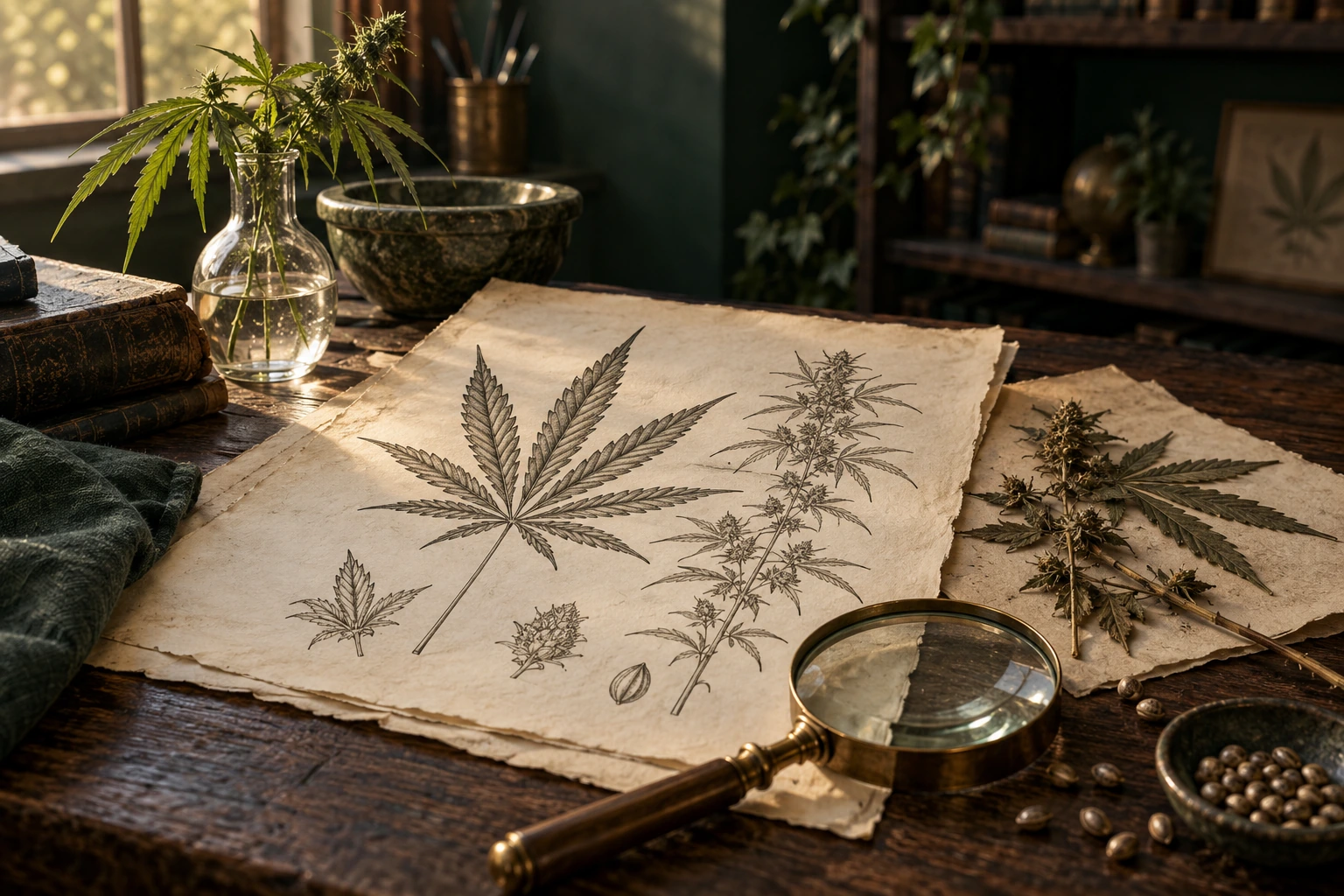
Imagined botanical archive · invented study sheets, not historical documents.
08 / Voices in the manuscript
Many voices, one herb
Arabic literary and legal traditions · al-Badrī’s anthology · 14th–15th centuries CE
Medieval Arabic writers disagreed about cannabis. Poets, historians and jurists described it in different ways, sometimes with praise and sometimes with disapproval. In the 1460s, al-Badrī gathered comments and verses in a work on wine and cannabis, including names used in different regions and occupations. These pages preserve the arguments people had about the plant. They do not give us one shared view, or a settled story of its discovery.
◌ Original research on historical manuscripts · 1 source
Read the evidence & its limits
Harvard scholar Adam Bremer-McCollum’s 2025 research reflection examines fourteenth- and fifteenth-century Arabic sources by historians, jurists and poets. It dates al-Badrī’s two-part collection to the 1460s and discusses regional vocabulary alongside opposing evaluations. These are textual witnesses read through historical scholarship. Their different voices help document how people wrote and argued about cannabis; they are not population surveys or a chronology of the plant’s arrival.
Where the evidence stopsThese writings do not express a universal Islamic position, prove a first use, or establish that every region shared the same practices. Literary voices must remain distinct from direct observation.
The Mary Rose · the Scheurrak SO1 wreck · 16th century CE
Hemp went to sea as working material. An anchor cable recovered from the Mary Rose and sailcloth from the Scheurrak wreck show how its fibres served aboard sixteenth-century ships. The Scheurrak vessel carried Baltic grain. After centuries underwater, these objects still connect the plant with the people who made ropes and sails, and with the ships that carried goods across the water.
◌ Surviving objects and conservation research · 4 sources
Read the evidence & its limits
The Mary Rose conservation team identifies its recovered anchor cable as hemp, with more than one hundred metres raised. The ship sank in 1545. NICAS identifies Scheurrak SO1’s surviving sailcloth as hemp fabric. The Dutch Cultural Heritage Agency describes that wreck as a merchant ship carrying Baltic wheat, lost shortly before 1600. These are documented material objects, rather than a general claim about every ship of the period.
Where the evidence stopsThese finds do not establish that all contemporary sails were hemp, identify where these fibres grew, or prove a maritime first. Scheurrak’s exact sinking date remains uncertain.
Colonial India · Calcutta and British medical publishing · 1839 / 1843 · 1893–94
When cannabis appeared in British medical reports, people in South Asia already knew and used it. That knowledge entered print within the unequal conditions of colonial rule. Later, an official inquiry examined cultivation, trade, consumption and possible prohibition. Its reports preserve observations and testimony, alongside the concerns of the officials who wrote them. To understand these records, we need to ask whose knowledge was included and who held the power to act on it.
◌ Historical medical report and colonial inquiry · 3 sources
Read the evidence & its limits
O’Shaughnessy’s 1843 journal publication identifies an earlier Calcutta report from 1839 and acknowledges Indian and Persian knowledge alongside his observations. The Indian Hemp Drugs Commission of 1893–94 subsequently assessed cultivation and consumption. Its report opposed total prohibition and favoured restriction through taxation, while considering harms and unintended effects. These are historical positions from a colonial inquiry, not the conclusions of a contemporary controlled clinical study.
Where the evidence stopsO’Shaughnessy did not discover that cannabis had medicinal uses. The Commission’s conclusions should be attributed to its historical setting and cannot establish that cannabis is harmless or effective as a modern treatment.
United States · Department of Agriculture · c. 1942
The American wartime film Hemp for Victory follows hemp from the field into manufacture: growing the crop, harvesting stalks, separating fibre and making useful materials. It shows the people and machinery involved in that work. It also had a job to do: encourage production for the war effort. Watching it today means keeping that purpose in mind.
◌ Original government film and archival record · 1 source
Read the evidence & its limits
The United States Department of Agriculture’s Hemp for Victory is dated circa 1942 in the National Agricultural Library archive. The film documents cultivation, harvesting and the manufacture and military uses of hemp fibre and coarse cloth. It is an original record of a specific wartime campaign, providing evidence of what that campaign promoted and how it presented the crop to its intended agricultural audience.
Where the evidence stopsA wartime promotional film is not a neutral account of the plant’s entire history. It does not mark the invention of hemp fibre or imply unrestricted permission for all cannabis cultivation and use.
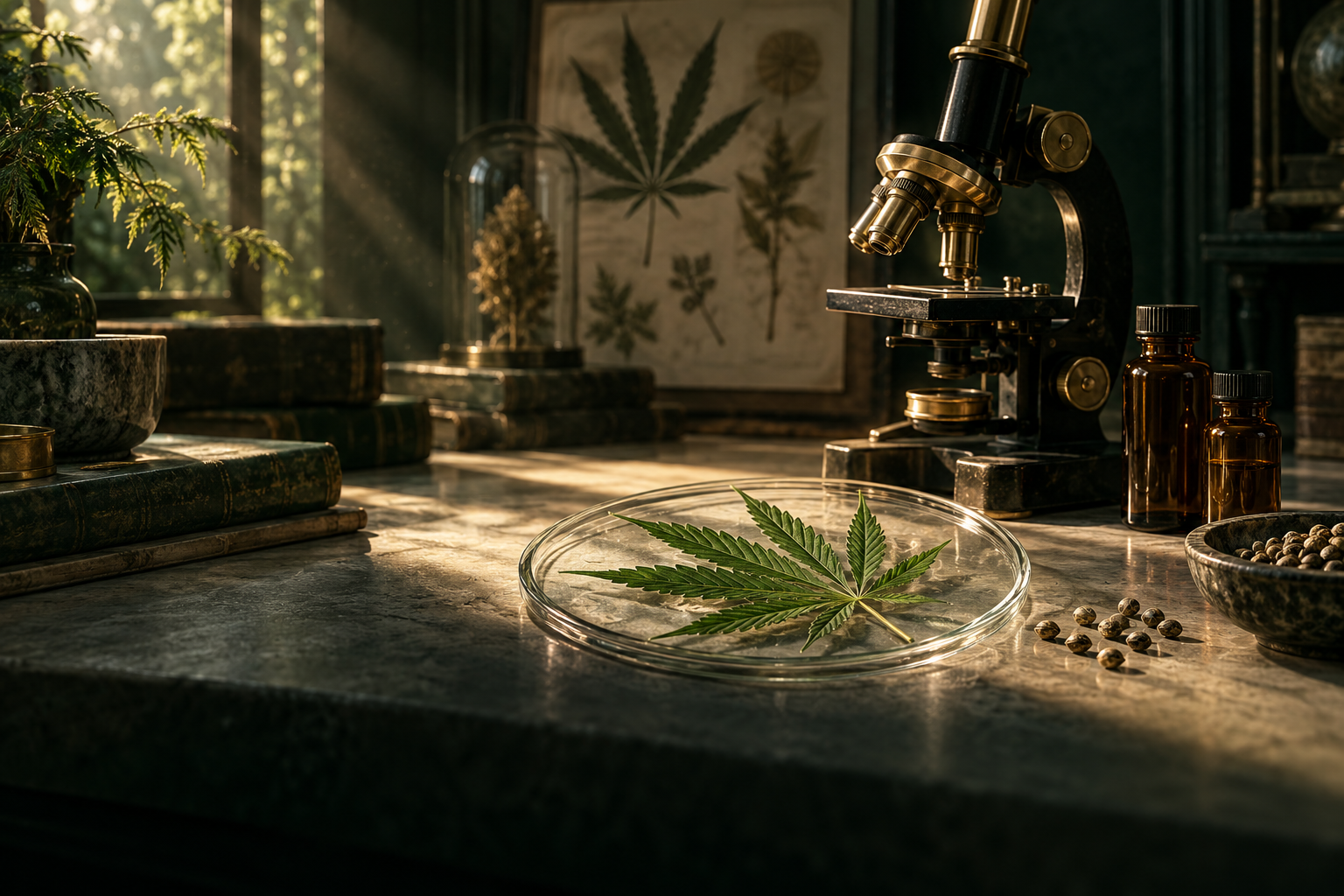
Imagined botanical laboratory · generated interpretation, not a photograph of a research site.
12 / Isolation and identification
A constituent becomes a structure
Israel · cannabinoid chemistry · 1964
In 1964, Yehiel Gaoni and Raphael Mechoulam reported the isolation and structure of the compound we now call Δ9-THC. Researchers could study a defined molecule more precisely than a plant preparation whose composition might vary. That was an important step in understanding cannabis chemistry. Questions about its effects, risks and possible medical uses still needed their own experiments.
◌ Original chemical research · 1 source
Read the evidence & its limits
Their April 1964 paper in the Journal of the American Chemical Society describes isolation, structural identification and partial synthesis of an active constituent of hashish. This is a foundational THC milestone, not the discovery of the first cannabinoid or the completion of every subsequent stereochemical and synthetic question. The historical publication date is 1964; a later date on a digital publisher record reflects online availability.
Where the evidence stopsIdentifying a molecule does not prove that a plant preparation treats a disease. THC chemistry should not be attributed to hemp seed oil or protein, and this paper was not a clinical trial.
India · the international treaty framework · 1985 · 1961 treaty context
When it comes to cannabis law, the part of the plant and its intended use matter. India's 1985 NDPS Act defines particular preparations within a longer history of international controls. Those definitions need careful reading. An exception in an international treaty does not, on its own, give someone permission under domestic law. And a legal classification tells us how something is regulated, not whether it works as a medicine.
◌ Primary legal instruments · 2 sources
Read the evidence & its limits
The NDPS Act was enacted on 16 September 1985 and came into force on 14 November. Section 2(iii) defines cannabis through charas, ganja and specified mixtures; seeds and leaves are excluded from ganja when unaccompanied by the tops. Section 14 allows government authorization, subject to conditions, for fibre, seed or horticulture. The 1961 Convention separately excludes cultivation exclusively for industrial fibre and seed or horticultural purposes from its application.
Where the evidence stopsThese provisions do not automatically authorize cultivation or establish blanket legality for bhang. This is historical legal context, not advice about a current activity; applicable permissions and rules depend on jurisdiction and circumstances.
Laboratory research · publication milestone · November 1988
Researchers studying rat-brain membranes found evidence that cannabinoids bind to a specific receptor. They now had a measurable way to investigate how that binding works.
◌ Original laboratory experiment · 1 source
Read the evidence & its limits
Devane and colleagues used a radiolabelled cannabinoid compound to characterize binding.
Where the evidence stopsAnimal-tissue binding is not a patient trial, and the receptor had not yet been cloned.
Laboratory research · publication milestone · 9 August 1990
Scientists cloned the receptor now called CB1 and showed that it could function. Studying its genetic sequence helped connect the instructions for making the receptor with the response it produced.
◌ Original laboratory experiment · 1 source
Read the evidence & its limits
Matsuda and colleagues reported a cannabinoid-responsive G protein-coupled receptor.
Where the evidence stopsThis was a cloning milestone, not discovery of the entire endocannabinoid system or proof of a treatment benefit.
Laboratory research · publication milestone · 18 December 1992
Researchers isolated anandamide from pig brain. This naturally occurring molecule could bind to the cannabinoid receptor, showing that a signal could come from within the animal itself.
◌ Original laboratory experiment · 1 source
Read the evidence & its limits
The work identifies an endogenous ligand, rather than a constituent supplied by the plant.
Where the evidence stopsIt does not mean the body needs cannabis, or establish a benefit from consuming it.
Laboratory research · publication milestone · 29 June · 4 October 1995
Two independent teams reported on another naturally occurring molecule involved in cannabinoid signalling: 2-arachidonoylglycerol, usually shortened to 2-AG. One team studied intestinal tissue; the other studied brain tissue.
◌ Original laboratory experiment · 2 sources
Read the evidence & its limits
Mechoulam and colleagues reported the intestinal-tissue finding in June; Sugiura and colleagues reported brain evidence in October.
Where the evidence stopsThese studies concern a cannabinoid-ligand role for an existing lipid. They do not map the complete signalling system or demonstrate clinical efficacy.
Dravet syndrome · a randomized trial · 25 May 2017
Understanding how a molecule works is only part of the question. Researchers compared a specified cannabidiol oral solution with placebo in 120 children and young adults with Dravet syndrome. Both were added to existing treatment so the trial could test whether this medicine made a difference.
◌ Randomized controlled trial · 1 source
Read the evidence & its limits
Over 14 weeks, convulsive seizures declined more with cannabidiol. Adverse events and withdrawals were more frequent.
Where the evidence stopsThis is evidence for a defined formulation and syndrome. It does not establish equivalent effects for seed oil, protein powder, every CBD preparation or all epilepsy.
United States · Food and Drug Administration · 25 June 2018
In 2018, the United States approved a cannabidiol oral solution for seizures associated with two severe epilepsy syndromes. The decision concerned one medicine, used for particular conditions, with its benefits and risks assessed. Those details matter. Evidence for that tested formulation does not tell us that every product labelled cannabis, CBD or hemp will have the same effects.
◌ Original medicine approval and safety documentation · 1 source
Read the evidence & its limits
The FDA’s original approval package for Epidiolex, dated 25 June 2018, covers seizures associated with Lennox–Gastaut syndrome or Dravet syndrome in patients aged two years and older at that time. The decision followed a product-specific assessment and included safety obligations, including attention to liver injury. This chapter records the initial 2018 authorization, rather than presenting its original indication and age range as the complete current prescribing label.
Where the evidence stopsThis approval does not cover hemp seed oil, protein, ordinary CBD products, whole cannabis or Mount Herbs goods. It is a U.S. regulatory milestone, not treatment guidance or a claim of universal safety.
United States · FDA supplemental approval · 31 July 2020
The US authorization for Epidiolex was extended to seizures associated with tuberous sclerosis complex, and to patients aged one year and older. This was another decision about who could be treated with this particular medicine.
◌ Official regulatory record · 1 source
Read the evidence & its limits
The supplemental approval follows the original 2018 authorization for Dravet and Lennox–Gastaut syndromes.
Where the evidence stopsThis US decision is not an Indian authorization, universal cannabis approval or evidence for consumer seed products.
United Nations · Commission on Narcotic Drugs · 2 December 2020
In December 2020, the United Nations Commission on Narcotic Drugs voted to remove cannabis and cannabis resin from Schedule IV of the 1961 Convention. This changed their classification within the treaty and acknowledged their medical uses, while international controls remained. It did not decide the law in every country. Governments still made their own decisions within their domestic legal systems.
◌ Official international scheduling decision · 2 sources
Read the evidence & its limits
Decision 63/17 was adopted on 2 December 2020 by 27 votes to 25, with one abstention. It deleted cannabis and cannabis resin from Schedule IV while their Schedule I status remained. The WHO’s explanation emphasized that international controls continued. The decision therefore should not be described as removing cannabis from all international schedules, legalizing it worldwide, or approving every cannabis-derived product as a medicine.
Where the evidence stopsInternational rescheduling does not automatically rewrite every domestic law. This event establishes neither commercial permission for a particular product nor clinical efficacy for a particular preparation, condition or person.
NIST · reference-material characterization · 20 June 2024
For laboratories to compare results, they need a common reference. NIST studied a dried, ground hemp material to help laboratories check their measurements of cannabinoids and toxic elements.
◌ Official technical publication · 1 source
Read the evidence & its limits
Reference Material 8210 has non-certified reference values intended for laboratory controls and research.
Where the evidence stopsA reference material is not certification of a brand’s products, proof of purity or evidence of treatment benefit.
Refractory chemotherapy nausea and vomiting · 16 August 2024
Some people still experience nausea and vomiting during chemotherapy despite standard medicines. A controlled trial tested an oral THC:CBD extract alongside those medicines. It asked whether the added treatment could help with these symptoms during cancer care.
◌ Randomized phase II/III trial · 1 source
Read the evidence & its limits
Among 147 evaluable participants, complete response was 24% with extract versus 8% with placebo. Sedation and dizziness were more common.
Where the evidence stopsComplete response meant no emesis and no rescue medication over 0–120 hours. It was not a tumour response or complete absence of nausea.
There is still much to learn about where cannabis came from and how it changed. Comparing many genomes reveals differences that a single reference plant cannot show, including changes in genome structure and cannabinoid-related genes. But even a large collection leaves questions. Which populations are wild, and which descend from cultivated plants? Which places have been sampled too little? More evidence may change the history we tell today.
◌ Original comparative genomics and open questions · 1 source
Read the evidence & its limits
Lynch and colleagues’ 2025 study assembled a cannabis pangenome resource comprising 193 genomes from 144 biological samples: 181 new assemblies and 12 existing ones. It documented extensive genomic diversity. A divergent Tibetan assembly contributed evidence suggesting wild relatives may persist in Asia, while the authors called for wider Asian and historical sampling. This complicates a simple account in which all wild progenitors have certainly disappeared.
Where the evidence stopsOne divergent genome does not prove a birthplace or settle wild versus feral status. A pangenome is a research resource, not evidence of a product’s clinical benefits or a final answer to domestication.
Clinical trials · specific conditions and formulations · 2025–2026
Recent studies have reached different answers about CBD and pain. In a larger fibromyalgia trial, placebo performed better than CBD. A small study of people with spinal cord injury found a modest signal of pain relief with CBD. To understand either result, we need to keep the condition, treatment and size of the study in view.
◌ Contrasting randomized trials · 2 sources
Read the evidence & its limits
Condition, formulation, comparator and follow-up must remain attached to every result. Later studies may fall outside an earlier review’s search cutoff.
Where the evidence stopsSelected evidence checked 3 October 2026; not an exhaustive or continuously updated review. Negative and uncertain results remain part of the story.